
Search Scott County Court Records
The main online search tool for Scott County court records is Minnesota Court Records Online Case Search, often called MCRO. It is operated by the Minnesota Judicial Branch and covers public state District Court cases. Scott County District Court is not a separate county-built court database, so MCRO is the first place to look for public case details, hearing entries, judgments, and available online documents.
MCRO offers Case Search, Document Search, Hearing Search, and Judgment Search. Name searches work best when the exact spelling is known. The Minnesota Judicial Branch warns that pending criminal, traffic, and petty misdemeanor cases with no conviction may not appear by defendant name, so a case-number search is often the better route for those matters.
- Open MCRO Case Search and accept the terms.
- Choose Name, Case Number, Citation Number, or Attorney search.
- For Scott County-only results, use the court location filter and select Scott County.
- Open View Case Details to read the Register of Actions, hearings, parties, charges, dispositions, and financial entries.
- Use Scott County Court Administration when a certified copy, older document, or non-online public file is needed.
The official MCRO overview is the source for the court-record search limits shown here.
The MCRO Case Search portal is the direct search source for Scott County District Court case lookup.
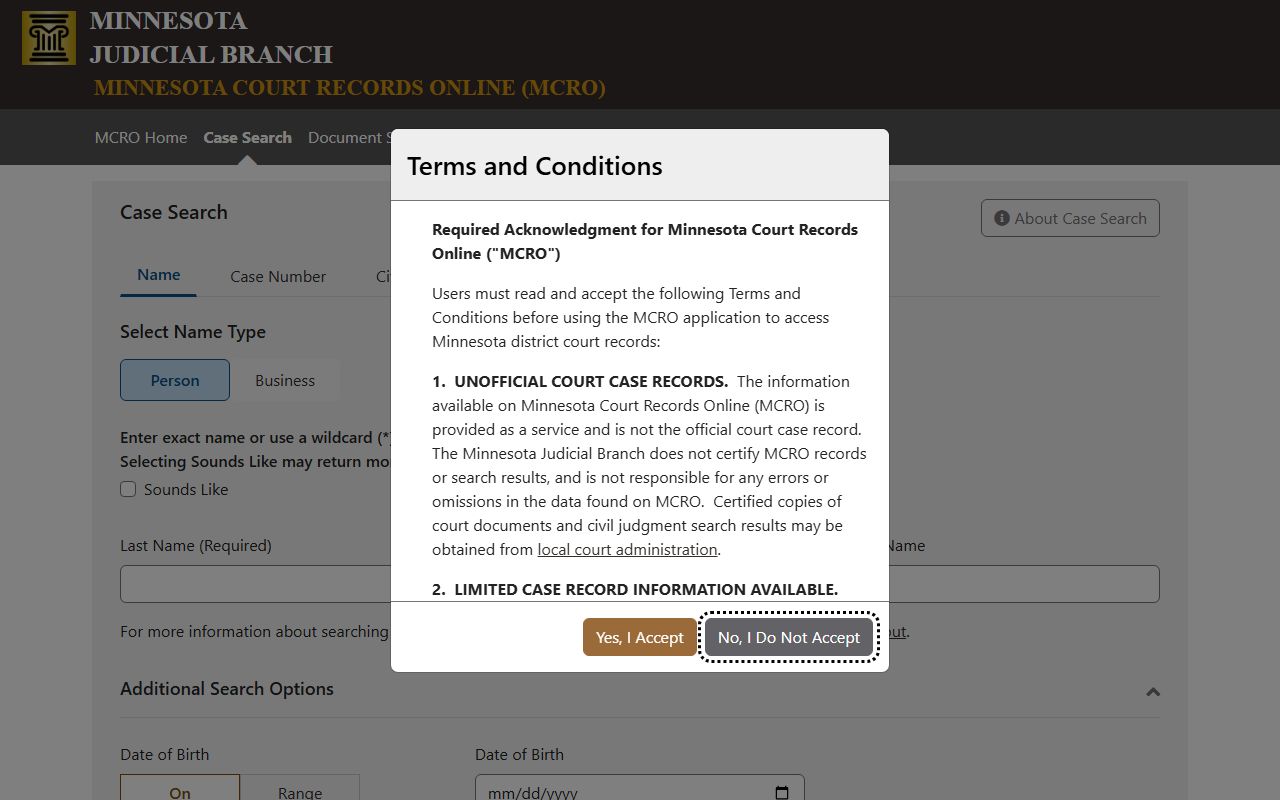
The portal is the starting point for public online case details before a certified copy request is needed.
Scott County Court Search Fields
MCRO search fields matter because small changes can change the result set. A name search is not a broad web-style search. The Judicial Branch guidance allows a wildcard after two characters and a Sounds Like option, but those two methods cannot be used together. Case and citation searches require a complete number, though dashes and leading zeroes may be omitted.
| Field | Use | Scott County Search Notes |
|---|---|---|
| Name | Person or business search | Last and first name for a person; exact-name searching with optional wildcard. |
| Case Number | Known court file lookup | Useful for pending criminal, traffic, and petty misdemeanor matters that may not show by name. |
| Citation Number | Traffic or payable citation lookup | Complete citation number, with or without dashes or leading zeroes. |
| Court Location | County filter | Select Scott County to narrow statewide Minnesota District Court results. |
| Date Filed | Date filter | Use exact or range only when the filing period is reliable. |
| Case Category | Topic filter | May include criminal, civil, family, probate, mental health, and other categories. |
Scott County Court System
Minnesota has a unified trial-court system. Scott County District Court is the primary trial court for Scott County and is part of the First Judicial District. The First Judicial District includes Carver, Dakota, Goodhue, Le Sueur, McLeod, Scott, and Sibley counties. The district page states that the district has 36 judges and more than 250 staff handling more than 95,000 cases each year across those counties.
Because Scott County uses District Court as the trial court, local court records are concentrated in one court level. Municipal prosecution and citation work can begin with cities or local law enforcement, but filed Minnesota trial-level criminal, traffic, civil, family, probate, and juvenile case records are handled in District Court.
| Court or Office | Role | Record Impact |
|---|---|---|
| Scott County District Court | Trial court | Civil, family, probate, juvenile, criminal, and traffic cases filed in Scott County. |
| First Judicial District | Regional state court administration | Scott County sits in this district with six other counties. |
| Minnesota Court of Appeals | Intermediate appellate court | Many appeals from District Court decisions move here. |
| Minnesota Supreme Court | Highest state court | Final state appellate authority and judicial-branch oversight. |
State case path: Scott County District Court › Minnesota Court of Appeals › Minnesota Supreme Court.
Scott County Court Contact
The Minnesota Judicial Branch lists Scott County District Court at the Scott County Justice Center in downtown Shakopee. Court Administration is the court-record office for District Court case files and certified court copies. The county facility pages also identify the same government campus for the Justice Center, Government Center, and Customer Service Center.
Scott County District Court
Scott County Justice Center, Government Center - JC115
200 Fourth Avenue W.
Shakopee, MN 55379-1220
952-496-8200
Fax: 952-496-8211
Court Administrator: Jennifer Everett
Minnesota Judicial Branch Scott County page
Scott County Customer Service
200 Fourth Avenue W.
Shakopee, MN 55379
952-496-8432
Marriage licenses and county vital-record services
Scott County Customer Service
The official Scott County District Court page is the source for the court's address, phone, jurisdiction, and Court Administrator listing.
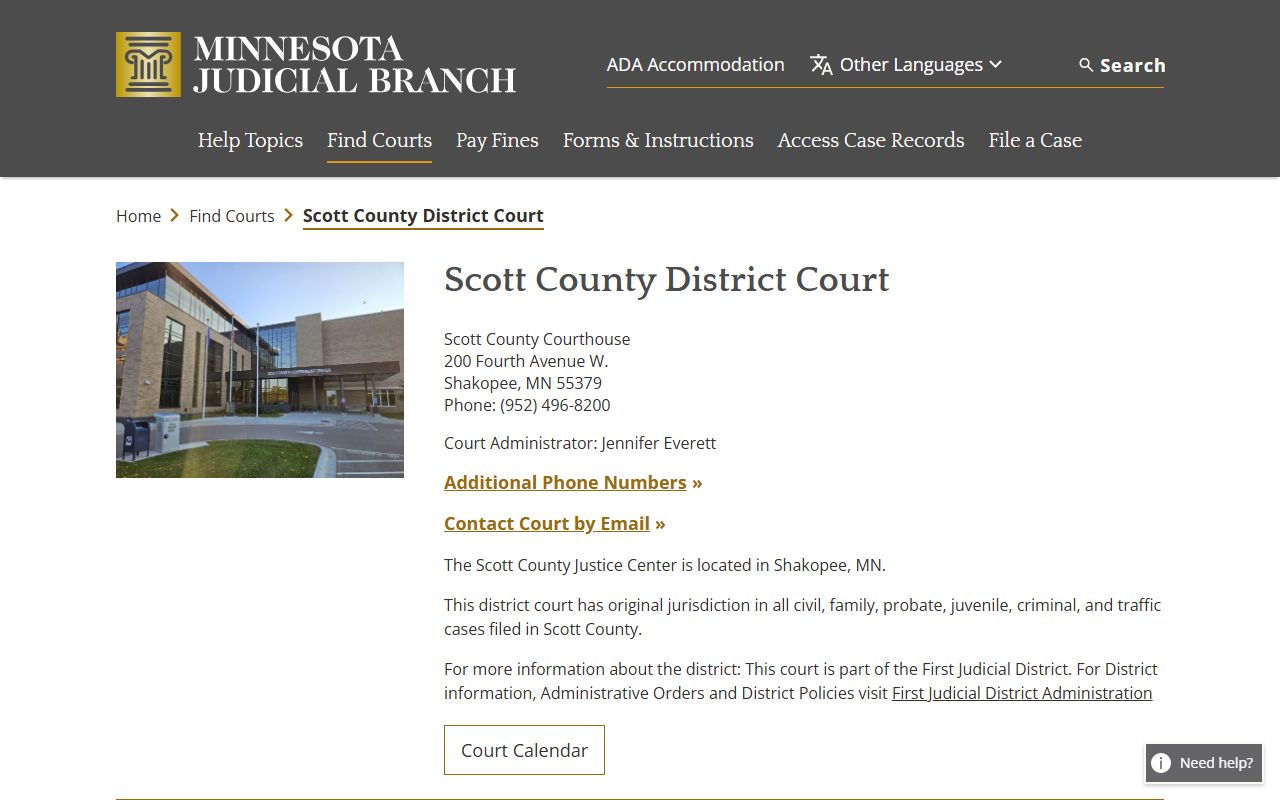
That court page is the local anchor for District Court records, copy requests, calendars, safety, and courthouse access.
The Scott County Justice Center facility page supplies the courthouse image used in this record-access context.
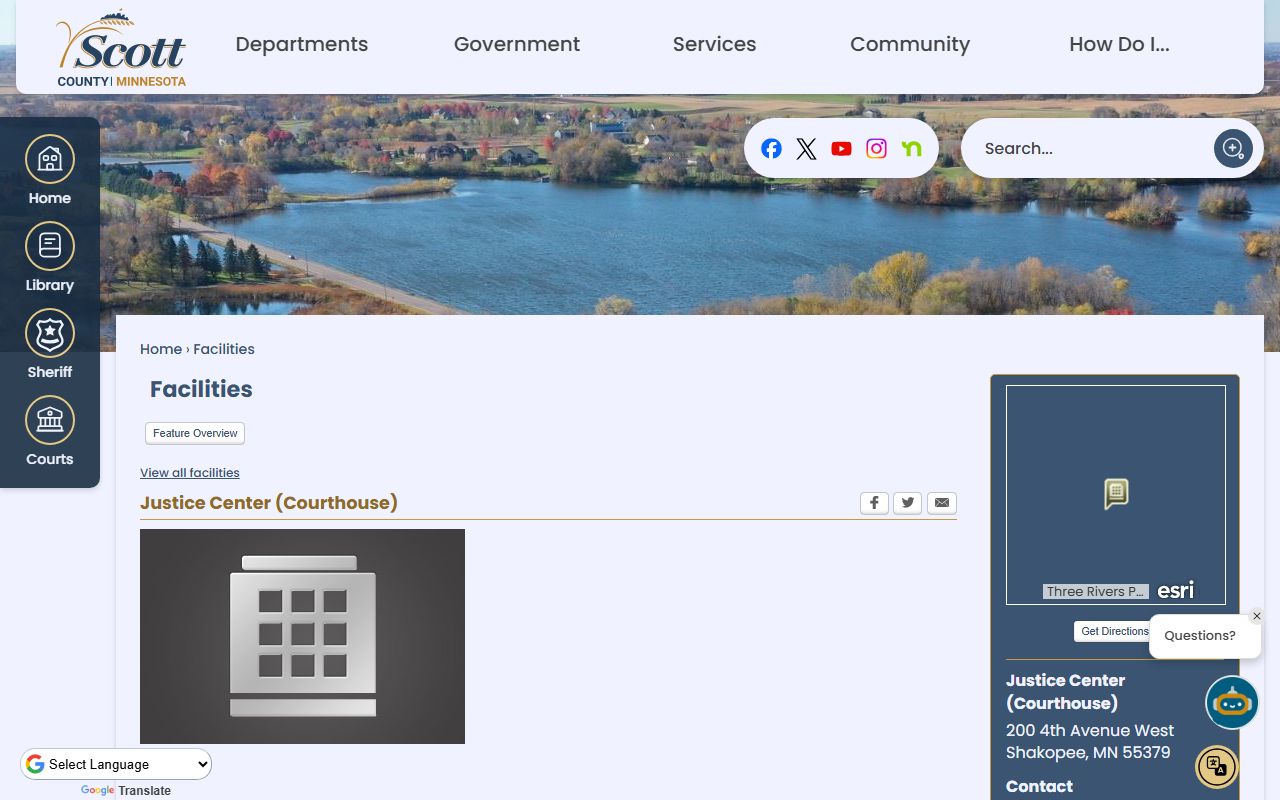
The Justice Center is the local point for District Court hearings, courthouse terminals, Court Administration, and certified Scott County court records.
Scott County Court Record Types
Scott County court records include several case groups, but they do not all have the same public access rules. Civil records can include complaints, answers, motions, orders, judgments, and conciliation court entries. Criminal case records may include complaints, charges, amended charges, appearances, warrants if present, pleas, dispositions, sentencing, bond or bail activity, fines, fees, payments, and credits.
Family records cover divorce, custody, parenting time, paternity, support, and post-decree matters. Probate records include formal probate, other probate, guardianship, conservatorship, and trust case types. Traffic and petty misdemeanor matters are District Court records, while state driver records are separate Driver and Vehicle Services files.
| Record Type | Where It Is Handled | Public Access Notes |
|---|---|---|
| Civil | Scott County District Court | MCRO and courthouse terminals, subject to Rule 4 limits. |
| Criminal | Scott County District Court | MCRO case details, with name-search limits for pending no-conviction cases. |
| Family and divorce | Scott County District Court | Online document access is narrower than for civil and criminal records. |
| Probate | Probate Division of District Court | Public post-2015 probate documents are often stronger online than family documents. |
| Traffic | Scott County District Court | Search by citation or case number; payable citations may route to Web Payment. |
Scott County Case Details
Scott County case numbers in public calendar examples use Minnesota court numbering patterns, with the county prefix 70 appearing in examples such as 70-CR, 70-CV, 70-FA, 70-VB, and 70-CO. MCRO case details are not just a list of names. They can show the Register of Actions, party roles, court events, document index numbers, charges, hearings, dispositions, warrants, and financial activity when those fields apply and are public.
| Field | What It Shows |
|---|---|
| Case Number | Scott County file identifier, often starting with the 70 county prefix in current examples. |
| Case Information | Title, case type, filing date, court location, judicial officer, status, flags, and related cases. |
| Party Information | Party role, name, city or state where shown, aliases, and attorney information. |
| Charges | Criminal accusations, multiple counts, and amended-charge history when public. |
| Hearings | Past and upcoming hearing rows, hearing type, time, and location when available. |
| Dispositions | Civil or family outcomes, or criminal plea, disposition, and sentencing details. |
| Financial Information | Fines, fees, payments, credits, and judgment details where applicable. |
Scott County Public Access Rules
Public access to Scott County court records comes from Minnesota court rules and state data law. Judicial Branch records are presumed open unless a statute, court rule, or court order restricts access. Remote access is narrower than courthouse access, so a record that is not shown in MCRO may still be available at a courthouse terminal or through Court Administration if it is public.
Key access rules for Scott County court records:
Minnesota Rules of Public Access, Rule 2 presumes Judicial Branch records are open during regular office hours unless an exception applies.
Rule 4 lists nonpublic case-record categories, including some juvenile, domestic abuse, health, adoption, and confidential filings.
Rule 8 explains inspection, copying, and why online remote access is narrower than courthouse-terminal access.
Minn. Stat. Section 13.03 presumes government data are public unless another law makes them not public.
The Public Access Rule 2 source is reflected in this Scott County court records page.
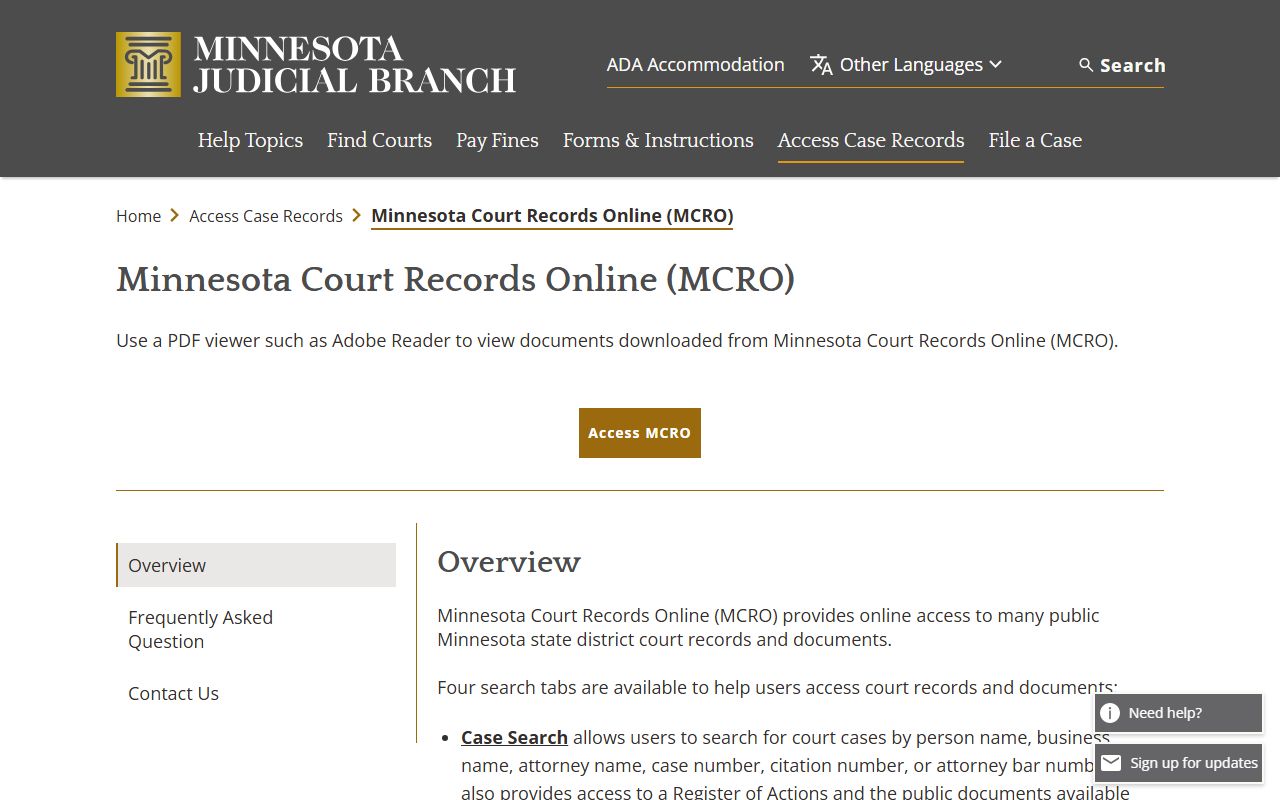
These rules explain why MCRO is useful but not a substitute for certified documents from Court Administration.
Restricted Scott County Records
Some Scott County court records are not open in the same way as ordinary adult civil or criminal files. Juvenile delinquency and protection records have special retention and release rules under Minn. Stat. Section 260B.171. MCRO also excludes Child Protection and Juvenile Delinquency Felony 16 case types from remote display.
Sealed and expunged records require extra care. Scott County Court Administration cannot provide confidential documents unless a judge signs an order granting access. Petition-based criminal expungement uses Minn. Stat. Section 609A.03, while eligible Clean Slate automatic expungement is addressed in Minn. Stat. Section 609A.015. Adoption records, civil commitment documents, medical identifiers, Social Security numbers, and certain domestic abuse or harassment materials may also be restricted.
Note: A missing online result does not prove that no Scott County court record exists.
Scott County Specialty Courts
Scott County Treatment Court is documented by the County Attorney's Office and county program materials. It is designed for nonviolent offenders with substance-use needs and is intended to improve public safety while reducing future criminal offenses. The local materials identify coordinator Robin Schultz at 952-496-8466 and rschultz@co.scott.mn.us, with the Treatment Court address at Government Center West in Shakopee.
The First Judicial District Veterans Treatment Court also serves Scott County. Program materials describe a process that includes coordinator contact, prosecutor pre-screening, releases, assessments, verification of military service, and a plea agreement before formal acceptance. These problem-solving courts are still court programs, so case access and record restrictions depend on the underlying District Court file and public-access rules.
Scott County Sheriff Records
The Scott County Sheriff's Office and the District Court handle different records. Sheriff's records cover law-enforcement reports, jail data, and in-custody information. Court Administration handles court case files, hearings, orders, certified copies, and District Court documents. The Sheriff's Records page states that the Sheriff's Office does not maintain court records and directs court-record questions to Court Administration.
The Jail/Warrants page identifies Scott County Jail as a 264-bed facility at the Law Enforcement Center in Shakopee. The jail roster is a static in-custody table, not the full criminal court file. The roster can show photo, MNI, name, sex, age, booking number, intake date, charges, statute numbers, and charge descriptions. Detailed jail roster use belongs with Scott County inmate records, while active warrant channels belong with warrant records.
The Scott County jail and warrants source supplies the jail context used for this high-level records overview.
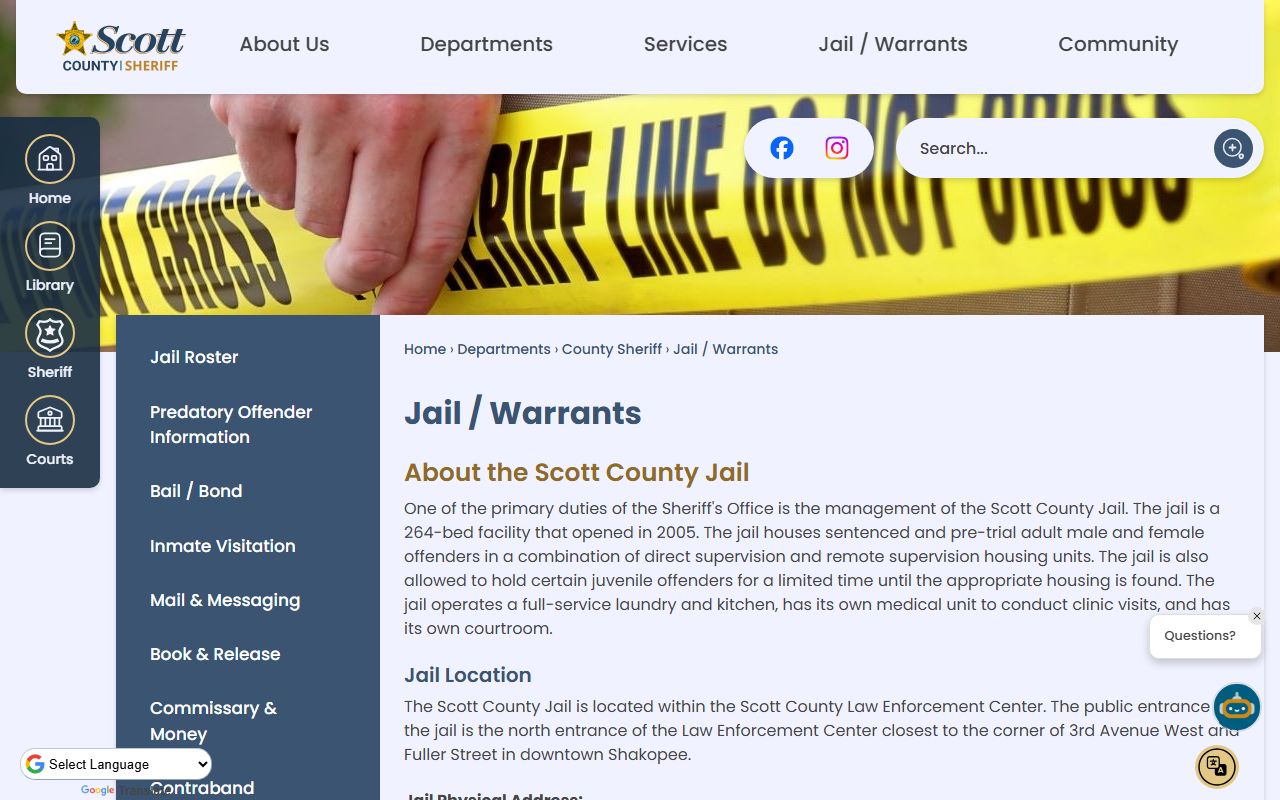
The key boundary is simple: custody and incident records are Sheriff's Office records, while filed case records are District Court records.
The Scott County data request page is the county-government source for public data requests outside the District Court case file.
County data requests can help with administrative or Sheriff's records, but court case copies still route through Court Administration.
Scott County Vital And Probate
Marriage licenses and certificates are handled by Scott County Customer Service, not District Court. A Scott County marriage license can be used anywhere in Minnesota and is valid for six months from issuance. Scott County does not participate in the Minnesota Official Marriage System, so certified certificates for licenses applied for in Scott County must be requested from Scott County.
Divorce and probate are different. Divorce decrees are District Court records, and certified divorce decree copies come from the county courthouse where the divorce was granted. Scott County probate matters are handled in the Probate Division of District Court, with MCRO, courthouse terminals, and Court Administration copy requests serving as the access channels.
- Certified copy
- A copy authenticated by Court Administration or the issuing county office for official use.
- Personal representative
- The person appointed in probate to manage estate duties.
- Small-estate affidavit
- A probate alternative that may be available under Minnesota rules when the estate qualifies.
Scott County Court Fees
Copy and filing fees vary by record type. The Judicial Branch copy request form lists no fee for a plain copy, but certified and exemplified copies carry a document fee. Scott County's fee page includes local law library adjustments for some filing categories, while marriage license fees are handled through Customer Service rather than Court Administration.
| Item | Amount |
|---|---|
| Plain court copy on copy request form | No fee listed |
| Certified court copy | $14 per document |
| Exemplified court copy | $14 per document |
| Certified and exemplified court copy | $28 per document |
| Dissolution of marriage filing, Scott County selected | $403 |
| Regular marriage license | $125 |
| Reduced marriage license with educator statement | $50 |
The Scott County copy request page is the local source for court-copy channels.
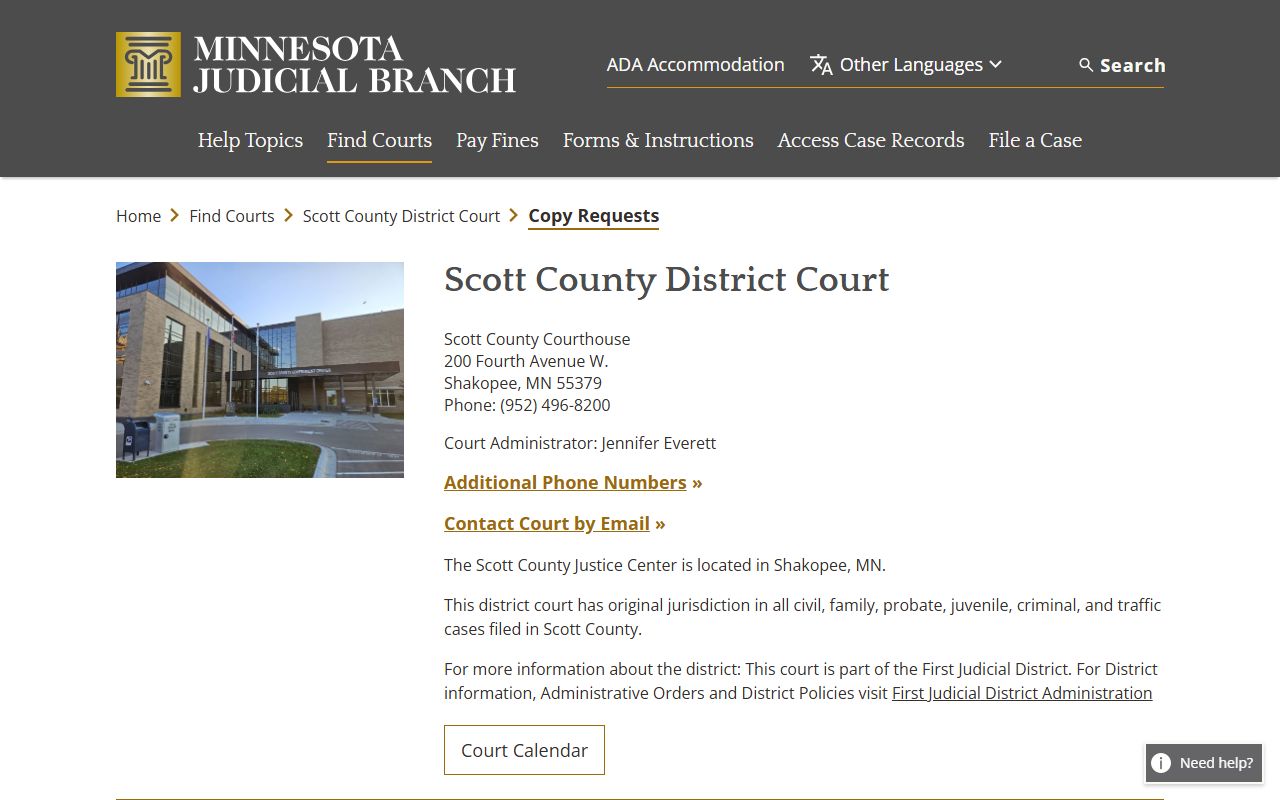
Certified court records should be requested from Court Administration, not downloaded from a search result.
Scott County Court Calendar
The Scott County Court Calendar is separate from MCRO case search. The court calendar page says the daily public calendar is posted at 7:00 p.m. for the next day's hearings and updated hourly beginning at 7:00 a.m. during court business hours. The calendar does not include every matter handled by the court, and confidential or non-remote cases are not posted.
Calendar rows can show party name, hearing location, date, time, judicial officer, hearing type, connection type or party role, and case number. If a case does not appear on the online calendar, printed calendars outside courtrooms and lobby display monitors are the most current source at the courthouse.
The Scott County calendar source shows how hearing information is separated from case-detail search.
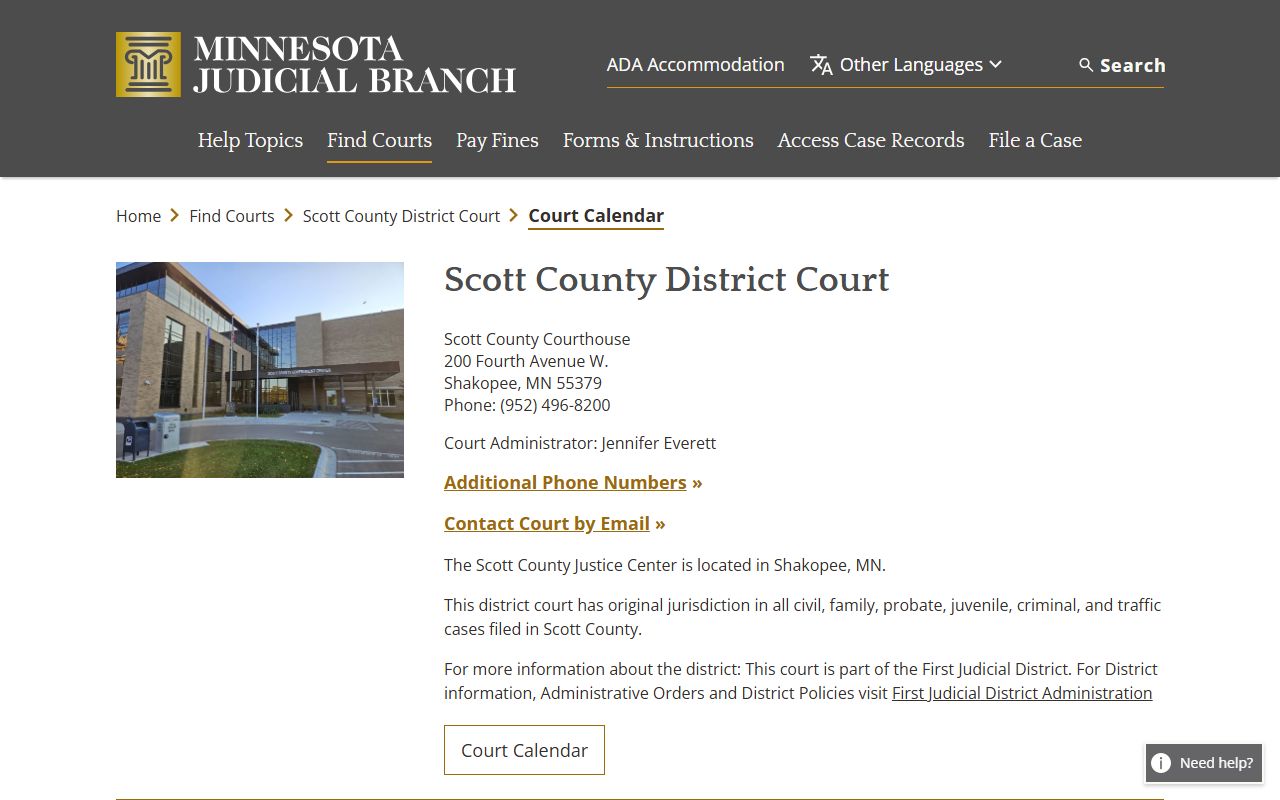
Calendar information helps find a hearing, while MCRO case details explain the case record itself.
Scott County Citation Payments
Payable Scott County traffic and petty misdemeanor matters may be handled through Minnesota Court Web Payment. The payment portal is not a complete court-record database. It is a payment channel for eligible citations and cases, while MCRO remains the route for case details and Court Administration remains the source for certified copies.
The Minnesota Court Web Payment portal is included because many Scott County court record searches start with a citation number.
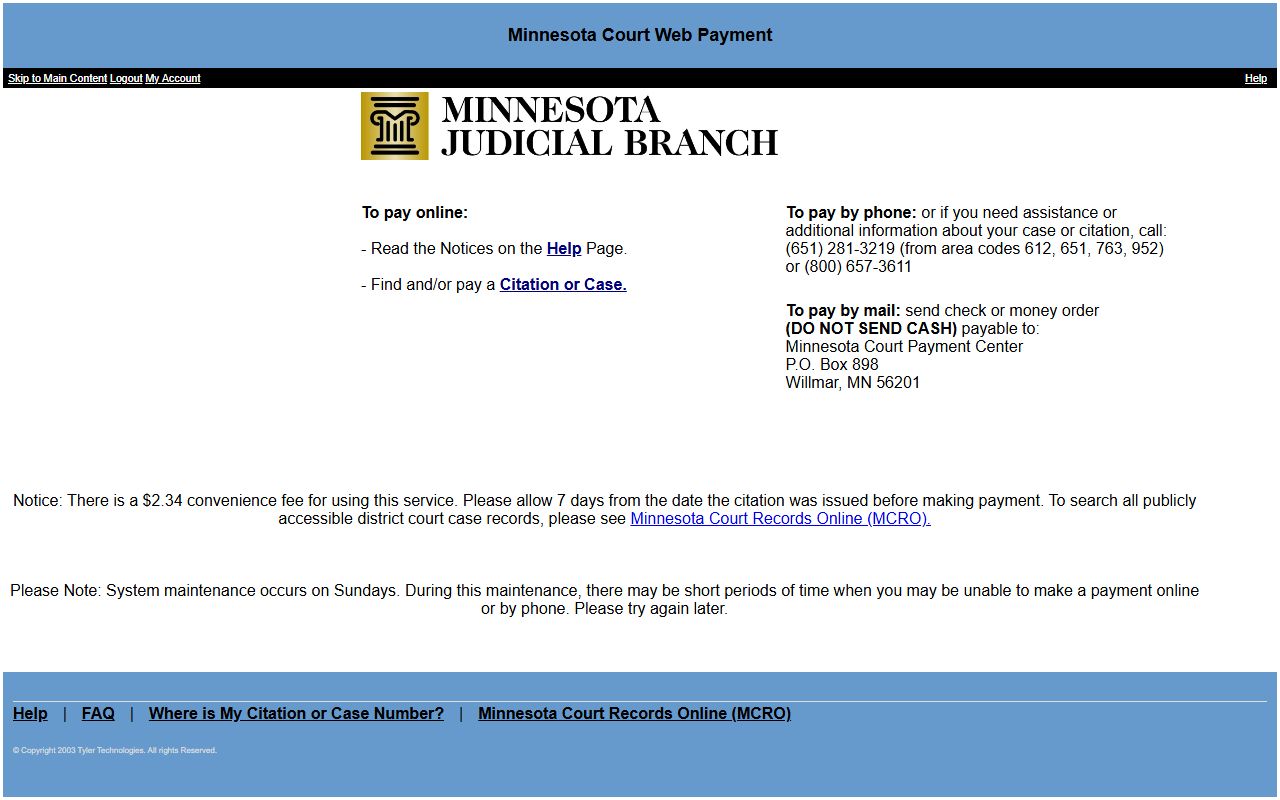
A payment result should not be treated as a certified court record or a complete driver-history record.
Scott County Service Counter
Scott County Customer Service is important for records that are not District Court case files. The office handles marriage licenses and county vital-record services. It is located on the first floor of Government Center East, and county orientation notes identify the 5th Avenue entrance between Holmes and Fuller Streets as the nearest entrance for Customer Service.
The Scott County Customer Service source explains the government campus entrance and drop-box details used by local record requesters.
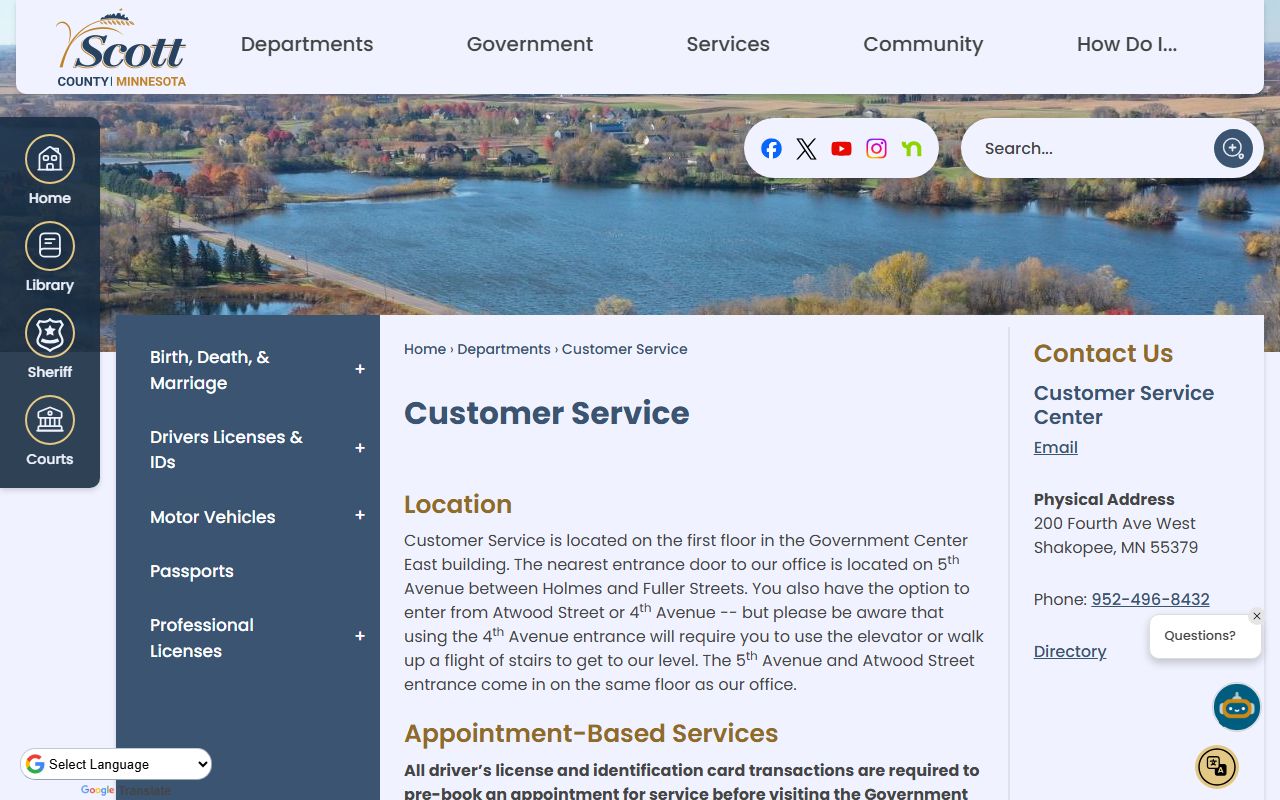
This distinction helps route marriage certificates to Customer Service and divorce decrees to District Court.
Scott County Court History
Scott County was organized in 1853, and Shakopee became the county seat in 1854. The official courthouse history says the first term of court was held in Holmes Hall in September 1853. Because the county did not have enough qualified grand jurors for ordinary numbers, the court convened with 24 grand jurors and 32 petit jurors.
County-seat fights shaped the courthouse. Jordan challenged Shakopee more than once, including an 1873 vote that Jordan lost by 92 votes. The modern courthouse was dedicated in 1976, and a Justice Center addition designed by WOLD Architect & Engineering was added in 1998. This history explains why the downtown Shakopee government campus remains the center for Scott County court records.
Scott County Court Records FAQ
Can Scott County court records be searched online? Yes. Public District Court case records are searched through MCRO. Some public documents are online, but courthouse terminals and Court Administration may provide fuller public access.
Who certifies Scott County court copies? Scott County Court Administration certifies documents from Scott County District Court. MCRO search results and downloaded records are not certified by the Judicial Branch.
Are Sheriff's records the same as court records? No. Sheriff's Office records include law-enforcement and jail records. Court records are District Court files handled through Court Administration, MCRO, or courthouse terminals.
Why is a case missing from a name search? MCRO limits remote access for several record types. Pending criminal, traffic, and petty misdemeanor cases with no conviction may require case-number searching.
Where are probate records filed? Scott County probate matters are filed in the Probate Division of District Court, not in a separate local probate court.
Where are marriage records handled? Scott County Customer Service handles marriage licenses and certified marriage certificates for licenses applied for in Scott County.
Public Record Search
Sponsored Results