
Scott County District Court
Scott County District Court is the primary trial court for Scott County and is part of Minnesota's First Judicial District. The Minnesota Judicial Branch states that the court has original jurisdiction over civil, family, probate, juvenile, criminal, and traffic cases filed in Scott County. That makes District Court the central case-record source for most filed court matters in the county.
The court is located at the Scott County Justice Center in downtown Shakopee. Court Administration, led locally by Court Administrator Jennifer Everett, handles District Court operations and record-copy requests. Minnesota does not split Scott County trial court records across separate county, justice, municipal, or probate courts in the way some states do.
Scott County District Court
Scott County Justice Center, Government Center - JC115
200 Fourth Avenue W.
Shakopee, MN 55379-1220
952-496-8200
Fax: 952-496-8211
Court Administrator: Jennifer Everett
The Scott County official website supplies county-government context for the courthouse campus and related local offices.
The county site is not the court-record database, but it helps identify the local campus and non-court county services.
Scott County District Court Table
Scott County does not have multiple numbered District Courts. The local trial-court case files are handled through one Scott County District Court within the First Judicial District. The table below treats the District Court and related court levels as the useful record-routing map for Scott County users.
| Court or Office | Type | Address | Phone |
|---|---|---|---|
| Scott County District Court | State trial court for Scott County | 200 Fourth Avenue W., Shakopee, MN 55379 | 952-496-8200 |
| Scott County Court Administration | District Court records and copies | Government Center - JC115, 200 Fourth Avenue W., Shakopee, MN 55379-1220 | 952-496-8200 |
| First Judicial District | Regional state judicial district | District-wide administration covering Scott and six other counties | See district page |
| U.S. District Court, District of Minnesota | Federal trial court | St. Paul and Minneapolis federal courthouses for metro-area users | 612-664-5000 for St. Paul clerk contact |
The Scott County courthouse history source gives local context for why the Shakopee courthouse remains the county's court center.
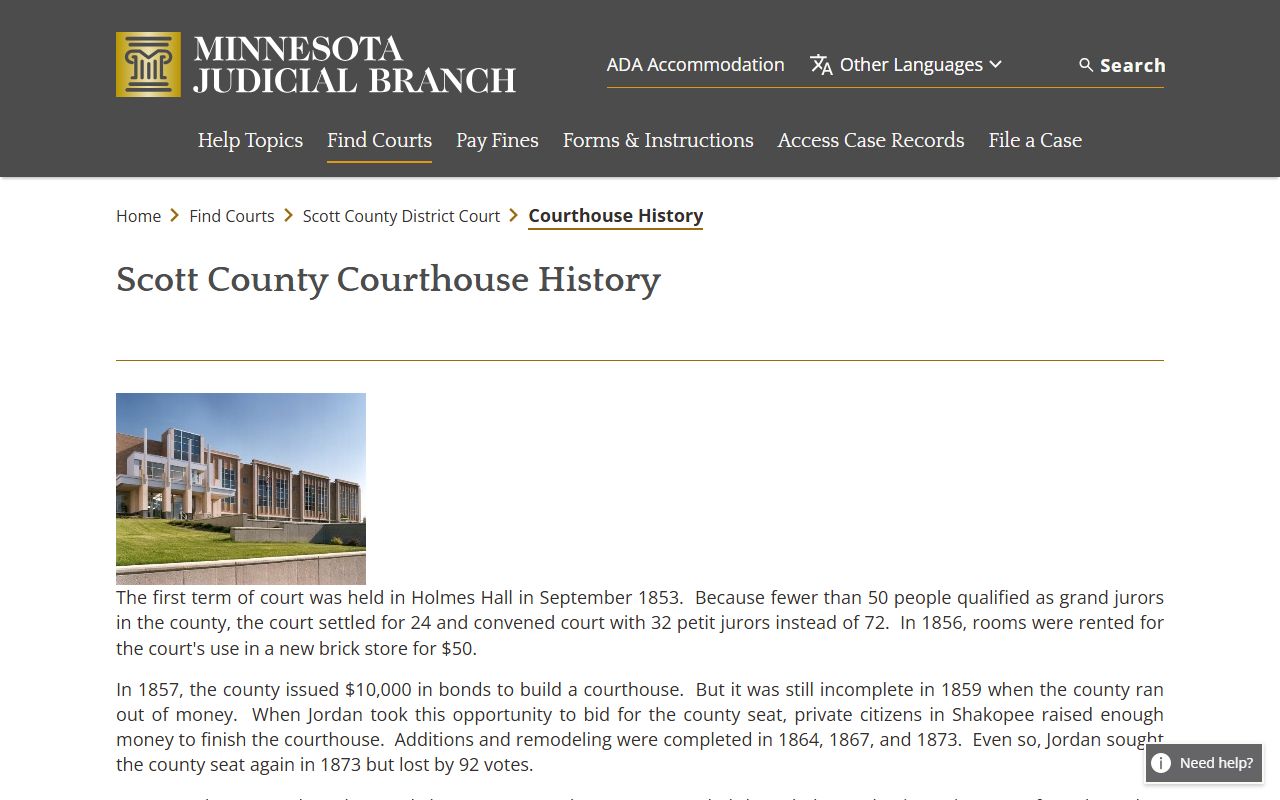
The history of the courthouse and county seat is tied directly to where Scott County District Court records are accessed today.
Scott County First Judicial District
The First Judicial District includes Carver, Dakota, Goodhue, Le Sueur, McLeod, Scott, and Sibley counties. The district page states that the district has 36 judges and more than 250 staff handling more than 95,000 cases each year across those counties. Scott County cases remain local District Court cases, but administration and judicial assignment sit within this regional state district.
Appeals from Scott County District Court generally move to the Minnesota Court of Appeals, with some matters or later review going to the Minnesota Supreme Court. That state appellate path is separate from federal appeals, bankruptcy cases, and federal criminal or civil filings.
State court flow: Scott County District Court › Minnesota Court of Appeals › Minnesota Supreme Court.
Scott County District Court Jurisdiction
Scott County District Court has original jurisdiction over the main filed trial-court case types in the county. Civil cases can include lawsuits, conciliation matters, evictions, judgments, and civil orders. Family cases include dissolution, custody, parenting time, paternity, child support, and post-decree filings. Probate includes formal probate, other probate, guardianship, conservatorship, and trust matters.
Criminal records include filed complaints, charges, hearings, pleas, dispositions, sentencing, warrants if present, bond or bail activity, and financial data. Traffic and petty misdemeanor records are also District Court records, although payable citations may be handled through Minnesota Court Web Payment when eligible. Juvenile records are handled in District Court too, but access is more restricted than adult case access.
| Case Type | District Court Role | Record Access Note |
|---|---|---|
| Civil | Filed civil actions, conciliation, eviction, judgments | Search MCRO or use courthouse terminals where public. |
| Family | Divorce, custody, paternity, support, post-decree | Online document access is limited mainly to orders, appellate opinions, and court notices for many post-2015 records. |
| Probate | Probate Division of District Court matters | Public documents filed on or after July 1, 2015 are often available online if remotely accessible. |
| Criminal | Charges, hearings, pleas, dispositions, sentencing | Pending no-conviction cases may require case-number search. |
| Traffic | Citations and petty misdemeanor court cases | Search by citation or case number; driver records are separate DVS files. |
District Court Vs City Citations
Scott County research did not identify separate municipal courts that maintain trial-level court records for the county. Minnesota trial-level court records are handled in District Court. Cities, prosecutors, and law-enforcement agencies may be involved before or around a citation or charge, but once a case is filed in court, the case record is a District Court record.
| Function | City or Law Enforcement | Scott County District Court |
|---|---|---|
| Traffic stop or incident | Creates citation or incident information | Receives filed traffic or petty misdemeanor case when court action is opened. |
| Prosecution | City or county prosecution may handle charging depending on offense | Tracks filed charges, hearings, dispositions, and financial entries. |
| Payment | May not be the court record source | Payable court citations may route through Minnesota Court Web Payment. |
| Certified case document | Does not certify District Court records | Court Administration certifies Scott County District Court documents. |
Scott County Case Flow
Case flow depends on the case type. A criminal matter may begin with arrest, citation, complaint, or warrant-related activity, then move through first appearance, arraignment, pretrial hearings, plea or trial, disposition, sentencing, and any appeal. A civil or family case begins with a filing, then service, response, hearings, motions, settlement activity, trial or order, judgment, and any appeal.
Criminal flow: Arrest or citation › complaint or charge filed › first appearance › arraignment or omnibus hearing › plea or trial › disposition › sentencing › appeal.
Civil and family flow: petition or complaint filed › service › answer or response › hearings and motions › settlement or trial › order or judgment › appeal.
- Register of Actions
- The docket-style list of filings, hearings, notices, and court events in a case.
- Disposition
- The outcome of a claim, charge, or case.
- Certified copy
- A copy authenticated by Court Administration for official use.
Scott County Daily Calendar
The Scott County Court Calendar page explains that the daily public calendar is posted at 7:00 p.m. for the next day's hearings and updated hourly beginning at 7:00 a.m. during court business hours. It does not include all matters handled by the court each day. Confidential cases and cases not remotely accessible under Rule 8 are not posted.
The calendar can be searched on a computer or mobile device by party name or attorney name. Printed calendars outside courtrooms and electronic display monitors in public lobbies contain the most current daily calendar information. A remote-hearing participant without technology or internet access may reserve the Law Library computer by calling 952-496-8713.
| Calendar Field | What It Means |
|---|---|
| Party Name | Name listed for the scheduled matter. |
| Hearing Location | Courtroom, Law Enforcement Center, Zoom, or remote hearing notation. |
| Time and Date | Scheduled hearing date and start time. |
| Judicial Officer | Judge or officer assigned for that calendar entry. |
| Hearing Type | Examples include first appearance, arraignment, plea, omnibus, sentencing, motion, probate, eviction, and conciliation hearing. |
| Case Number | Scott County examples include 70-CR, 70-CV, 70-FA, 70-VB, and 70-CO formats. |
Scott County Courthouse Safety
Scott County courthouse safety guidance tells parties to contact Court Administration at 952-496-8200 before court if safety assistance is needed so staff can notify a Sheriff's deputy. At the courthouse, a person can ask a deputy at weapons screening, a deputy in the courtroom, a bailiff, or the court clerk for help. A bailiff or deputy may also be asked to walk someone to a vehicle.
The weapons screening page says courthouses have metal detectors. Prohibited examples include firearms, cutting tools or bladed instruments, stun guns, tasers, mace, pepper spray, protective chemical aerosols, ammunition, explosives, and other items capable of serious bodily harm. Confiscated dangerous items are not returned.
Note: The Government Center facility page lists the courthouse campus as ADA Accessible.
Scott County Court History
Scott County's court history began early in Minnesota's territorial period. The official courthouse history says the first term of court was held in Holmes Hall in September 1853. The county could not assemble ordinary grand and petit jury numbers because fewer than 50 people qualified as grand jurors, so the court used 24 grand jurors and 32 petit jurors.
County-seat disputes shaped the courthouse. Jordan challenged Shakopee for county-seat status more than once and lost an 1873 challenge by 92 votes. The modern courthouse was dedicated in 1976, and a Justice Center addition was built in 1998. Scott County's growth, Minnesota River history, and downtown Shakopee government campus still frame how District Court records are found today.
The Scott County history source adds county-seat and local history context for District Court users.
Local history is useful because the courthouse campus remains tied to Shakopee's role as county seat.
Scott County Federal Court
Federal cases are not Scott County District Court records. Scott County is in the U.S. District Court for the District of Minnesota for federal civil and criminal cases. For Scott County users, the St. Paul and Minneapolis federal courthouses are the practical metro-area locations. The St. Paul federal courthouse page lists the Warren E. Burger Federal Building and U.S. Courthouse at 316 North Robert Street, Suite 100, St. Paul, MN 55101, with Clerk of Court Kate Fogarty at 612-664-5000.
Federal record access uses PACER and CM/ECF, not MCRO. The District of Minnesota PACER guidance covers NextGen PACER procedures, account linking, registration, and public terminal access for certain unsealed materials. Bankruptcy cases for Scott County are handled by the U.S. Bankruptcy Court for the District of Minnesota, with Scott County assigned to the St. Paul office.
| Record Question | Use | Do Not Use |
|---|---|---|
| Scott County state criminal, civil, family, probate, traffic case | MCRO or Scott County Court Administration | Federal PACER |
| Federal criminal or civil case | District of Minnesota and PACER | Scott County District Court |
| Bankruptcy case | U.S. Bankruptcy Court for the District of Minnesota | Scott County District Court |
| Federal appeal | Eighth Circuit Court of Appeals | Minnesota Court of Appeals |
The District of Minnesota St. Paul courthouse source shows the federal courthouse used for Scott County federal-court context.
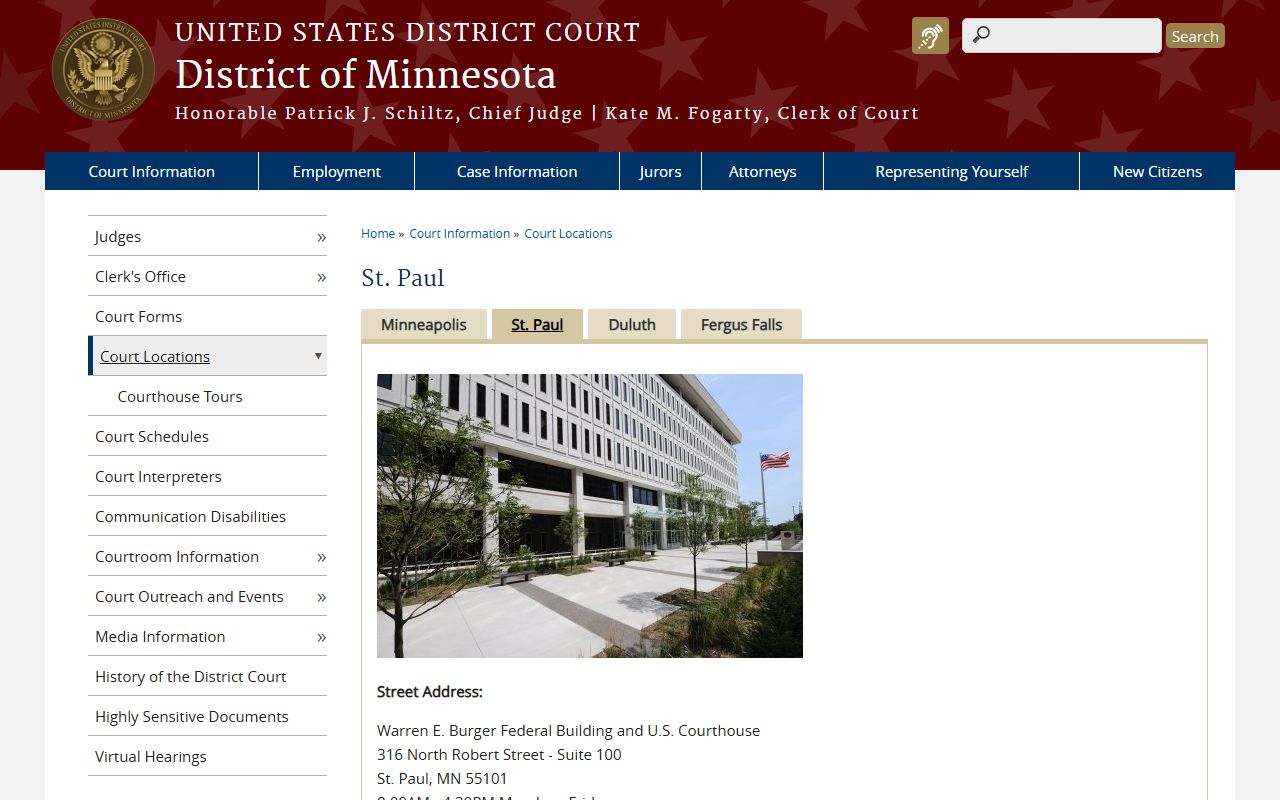
Federal courthouse records are separate from Scott County District Court records even when the person or event is local.
The District of Minnesota PACER source explains how federal court records are accessed.
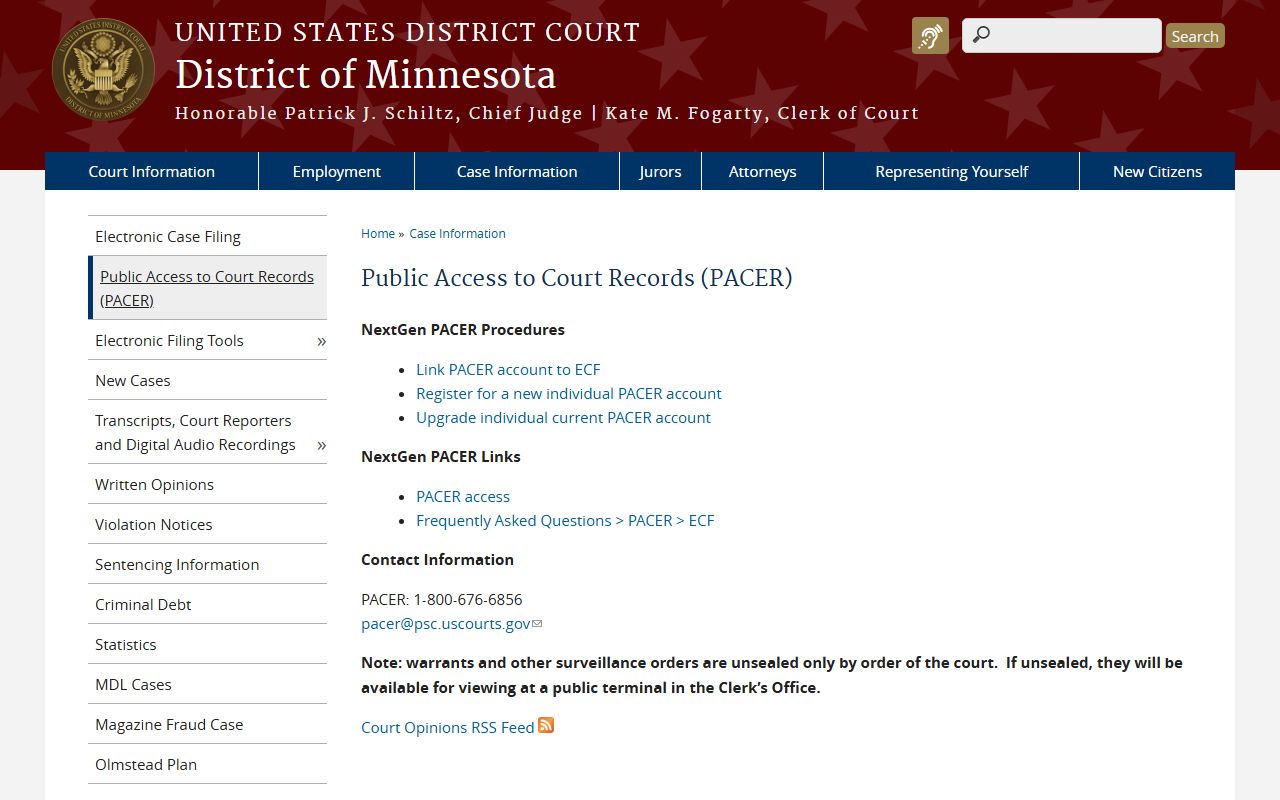
PACER is the federal record system, while MCRO is the Minnesota state District Court search tool.
Search Scott County District Court
Scott County District Court record access works best when the court level is identified first. State trial-court records use MCRO, courthouse terminals, and Scott County Court Administration. City citation activity, Sheriff's Office reports, federal cases, and bankruptcy records use different channels.
Public Record Search
Sponsored Results