
Scott County Arrest Records
Scott County arrest records start on the law-enforcement side. The arrest or booking record can show custody status, booking number, intake date, name, age, sex, photo, visible charge rows, statute numbers, and custody or case status codes when the person is listed on the jail roster. Those records are maintained by the Sheriff's Office and jail records channels, not by Scott County District Court.
Court charge records start when the governmental authority files formal charges. Minnesota Court Records Online describes charges as formal accusations, usually by a prosecutor or police. In Scott County, criminal charges filed in District Court can appear in MCRO case details when the case is public and remotely accessible. Multiple charges can appear in one case, and amended charge history may display below current charges.
The Scott County Sheriff's Office source identifies the local law-enforcement office tied to jail, warrant, and records channels.
That sheriff channel is the custody and law-enforcement side of the arrest-to-charge record path.
Scott County Court Charges
Scott County court charges are searched through the statewide MCRO system because Scott County District Court is part of Minnesota's unified trial court system. The court charge record can show the filed charge, statute number or offense reference, charge level, amended charge history, hearings, interim conditions, warrants if present, bond or bail activity, disposition, and financial entries where those sections apply.
MCRO is useful for court charges after arrest, but it has a major limit. Pending criminal cases with no conviction do not return by defendant name. Those cases may return by case number. That is why a person with a citation, complaint, summons, jail paperwork, or court file number should search by case number when possible.
- Open MCRO Case Search and accept the terms.
- Use case-number search if the court file number is known, especially for pending no-conviction matters.
- Use name search carefully for public cases where remote name access is allowed.
- Filter court location to Scott County when the search needs only local District Court results.
- Open case details and review the Charges, Warrants, Hearings, Dispositions, Bond/Bail Activity, and Financial Information sections.
For the full case file and sentencing path, the Scott County criminal court records page is the better reference. For current custody and booking rows, use the Scott County inmate records page.
Charges After Scott County Arrests
The charge record begins with a charging document. In Minnesota county practice, the Scott County Attorney prosecutes felonies, gross misdemeanors, and misdemeanors occurring in Scott County. The filing may be a complaint, information, or indictment depending on the case type and procedure. The research specifically documents 2026 official Scott County Attorney indictment news releases, so indictment is a real local term for serious cases, not just a generic label.
| Charging Document | Filed or Approved By | Common Use | What to Check |
|---|---|---|---|
| Complaint | Prosecutor or law-enforcement-supported filing | Common criminal charging document | Counts, statute numbers, probable cause facts, and summons or warrant status where public. |
| Information | Prosecutor | Formal prosecutor charge path in cases where used | Filed charges, amendments, and court events. |
| Indictment | Grand jury | Serious felony cases, including official Scott County Attorney news examples | Indicted counts, case number, and later court proceedings. |
Charge documents should be read with later case events. A first-filed charge may be amended, dismissed, reduced, or resolved by plea or verdict. MCRO's case detail can show a current charge and amended history, but certified copies and official court documents must come from Court Administration when needed.
Scott County Charge Status
Charge status shows where an accusation stands in the court process. A charge row is not the same as a conviction. One arrest can produce several counts, and each count can move differently. Some counts may remain pending, some may be amended, and some may be dismissed while another count continues.
| Status | What It Means | Where It May Appear |
|---|---|---|
| Pending | The accusation has not reached final disposition. | MCRO charge details, hearings, and interim conditions. |
| Amended | The charge changed after initial filing, often by count, level, or statute description. | MCRO amended charge history where available. |
| Reduced | The charge level or offense changed to a less serious accusation. | Charge rows and disposition history. |
| Dismissed | The charge ended without a conviction on that count. | Disposition or event entries. |
| Convicted | A guilty plea, verdict, or adjudication produced a conviction on that count. | Disposition and sentencing sections. |
MCRO's warning about pending no-conviction cases is central here. A name search may miss a pending charge record that a case-number search can find.
Scott County Charge Fields
MCRO case details can include a detailed charge and case inventory when the case is public and available online. The record can also include warrants, hearings, dispositions, bond or bail activity, fines, payments, and credits. A charge row should be read as one section of the case, not the entire record.
| Field | What It Shows |
|---|---|
| Case number | Scott County case examples use the 70 prefix, such as 70-CR for criminal and 70-VB for violations bureau matters. |
| Case type | Criminal, traffic, or petty misdemeanor category where applicable. |
| Charges | Formal accusations, multiple counts, and amended charge history where shown. |
| Warrants | Active warrant flags and warrant information if an active warrant applies and is public. |
| Interim conditions | Conditions imposed while the case is pending. |
| Hearings | Upcoming and previous hearing details. |
| Dispositions | Plea, dismissal, conviction, sentencing, or other case outcomes. |
| Bond/Bail Activity | Amounts, status history, and posted bond or bail where entered. |
The MCRO field set helps connect the arrest-to-charge path with later court action, but MCRO is not certified as the official record copy.
Scott County Jail Charge Rows
The jail roster charge rows are current-custody entries. The researched Scott County roster showed a photo, MNI, name, sex, age, booking number, intake date, and charges. Charge rows can include statute numbers and descriptions, with examples in the research such as drug possession, failure to appear, assault, and counterfeiting.
Roster status and level codes can include F, G, M, A, P, Court/Pending, Bail/Bond Set, Hold for Another Agency, Sentenced, Sentence Complete, ROR, or RPR. Bond amount data appeared commented out in the roster HTML and was not visibly displayed in the public table captured for research. That matters because a jail row may show a charge without giving a full bail picture on screen.
The county Jail Data Request page is the official path for general jail booking records and booking-photo/public in-custody requests.
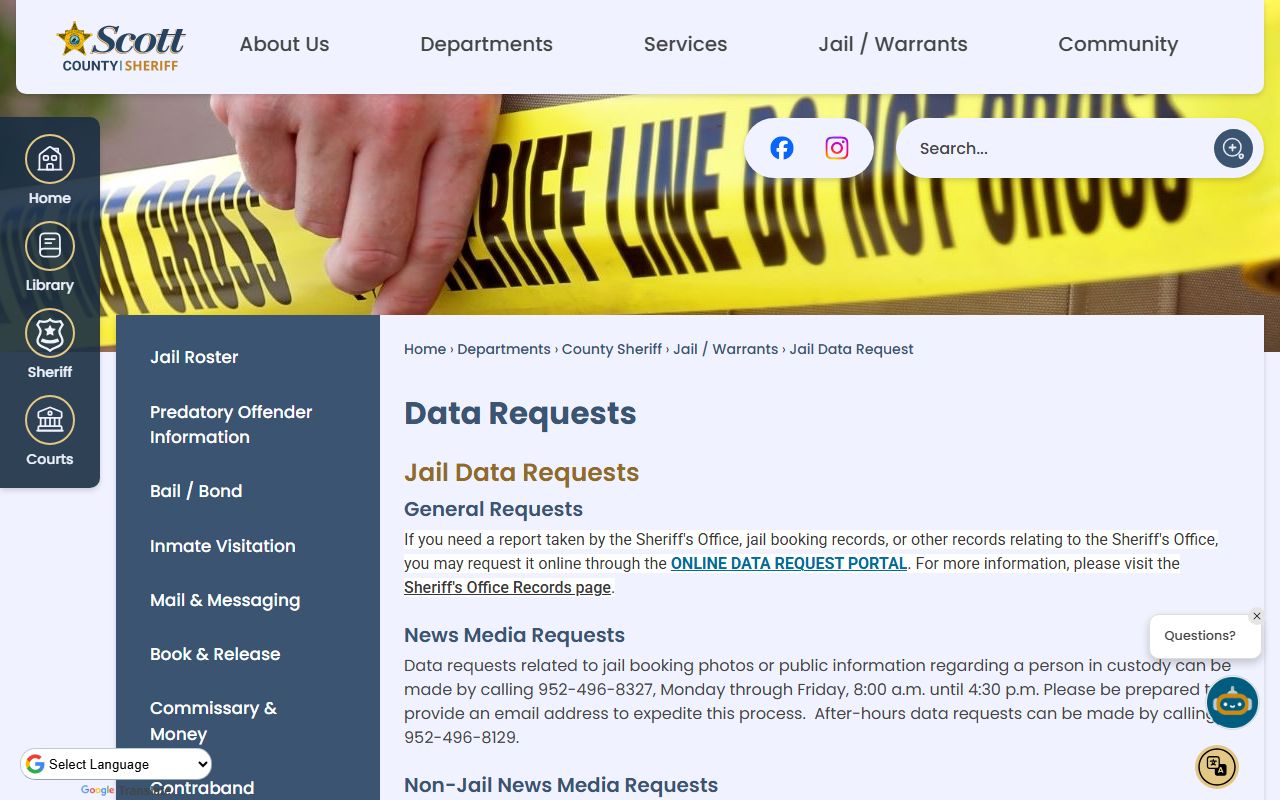
Jail data requests can supplement a roster view, while the court charge record remains with District Court.
The Sheriff's Records page is another official law-enforcement request channel.
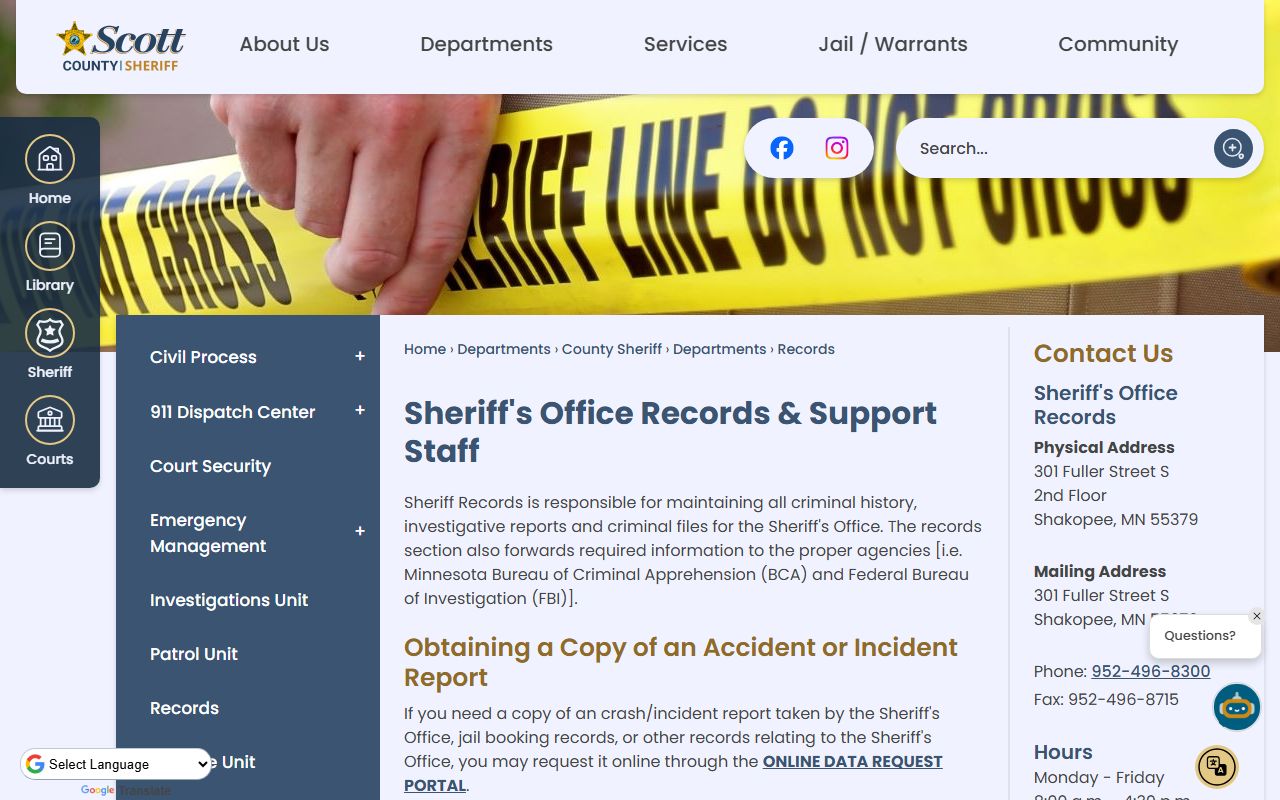
Sheriff records are useful for law-enforcement reports, but the page itself directs court-record questions to Court Administration.
Scott County Attorney Charges
Minnesota counties use County Attorney terminology rather than District Attorney. The Scott County Attorney's Office prosecutes felonies, gross misdemeanors, and misdemeanors occurring in Scott County and represents the county in civil litigation involving the county. The office address in the research is GW-300 Government Center West, 200 Fourth Avenue West, Shakopee, MN 55379. Phone is 952-496-8240, and fax is 952-496-8775.
Ron Hocevar is listed as current County Attorney in the research. The staff directory also lists Sarah Wendorf as Chief Deputy, Michael Groh as First Assistant, Steve Kelm as Criminal-Misdemeanor Division Head, Debra Lund as Criminal-Felony/Juvenile Division Head, Jeanne Andersen as Civil Division Head, and Tera Portinga as Victim/Witness Coordinator at 952-496-8242.
The County Attorney page is the main official source for the prosecuting office.
The prosecutor's role is the key link between a law-enforcement arrest and formal court charges.
The County Attorney directory provides office and staff context for charge-related prosecution functions.
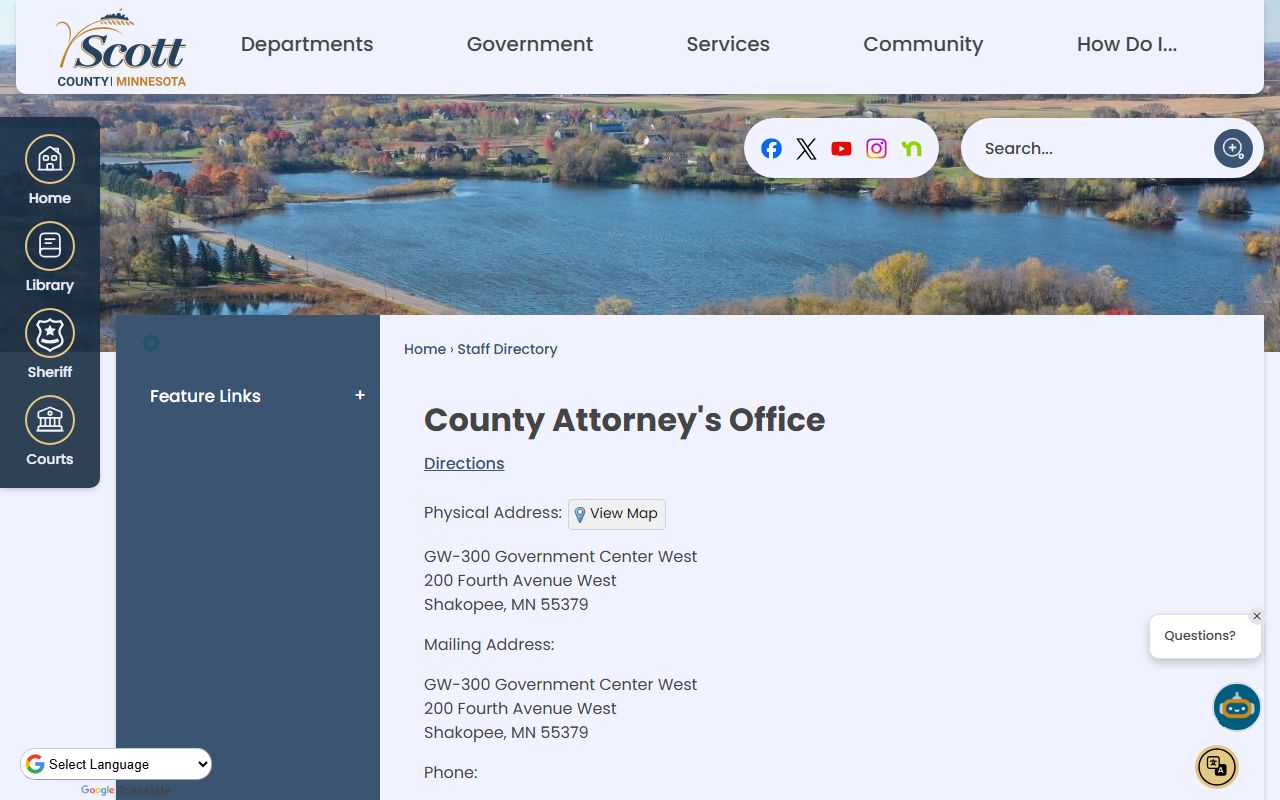
Directory details should be used for official office routing, not as legal advice about a pending case.
Scott County Discovery Requests
The Scott County Attorney discovery request form is not a public data request. The form notice says it is for discovery requests only, and only defense attorneys, pro se defendants, or a party to the criminal case should use it. The fee is $15.00 unless the requester is a victim. Accepted payment methods are cash, check, credit card, and money order.
Payment can be made in person, by credit card over the phone at 952-496-8240, or by mailing check or money order payable to Scott County Attorney's Office, ATTN: DISCOVERY, 200 Fourth Avenue West, Shakopee, MN 55379. Juvenile matter requests must come from the parent or juvenile, and the parent or juvenile must pick up the report in person. Copies are available in approximately 10 days.
| Discovery Field | Type | Required / Notes |
|---|---|---|
| Date | date/text | Required. |
| State of Minnesota vs. | text | Required defendant or case caption. |
| Court File No. | text | Optional court file number. |
| Police reports occurred on | date/text | Required report date. |
| For the offense of | text | Required offense description. |
| I choose to | dropdown | Phone pickup notice, email pickup notice, email documents, or mailed documents. |
| I am a | dropdown | Victim, Attorney, Defendant, or Other. |
The discovery form is an official prosecuting-office source for parties entitled to discovery.
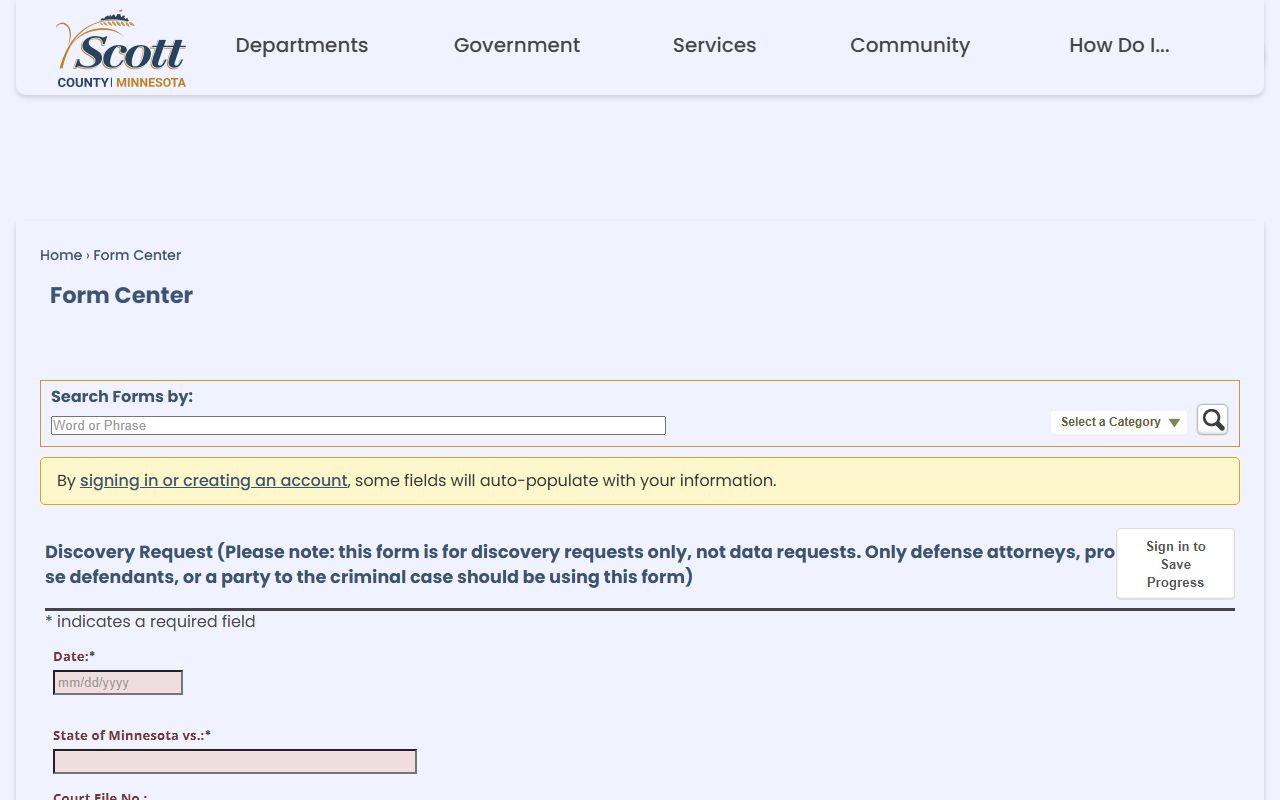
It should not be used as a substitute for MCRO, Court Administration copy requests, or Sheriff's public data requests.
Charges vs Convictions
A charge is an accusation. A conviction is a final criminal finding by plea, verdict, or adjudication. Scott County arrest records can show a person was booked, and court charge records can show accusations filed after arrest, but neither fact alone proves a conviction on every count.
| Point | Charge | Conviction |
|---|---|---|
| Stage | Filed accusation in a criminal case. | Outcome after plea, verdict, or adjudication. |
| Record source | MCRO charge rows, complaint, jail roster charge rows for custody context. | Disposition and sentencing sections, plus BCA public conviction history where eligible. |
| Can change? | Yes, charges may be amended, reduced, or dismissed. | May later be appealed, corrected, sealed, or expunged under law. |
| Background use | Should not be treated as proof of guilt. | Still must be used within FCRA and other legal limits. |
Note: A charge row, booking row, or warrant flag should be matched to the case record before drawing conclusions about outcome.
Scott County BCA Limits
The Minnesota Public Criminal History Search from DPS and BCA is the correct statewide source for public conviction-history checks. It is a free service, but it is not an arrest database and it is not a full court file. Public data includes conviction data public for 15 years after sentence completion, including offenses, courts of conviction, conviction dates, and sentencing information.
The BCA website does not provide arrest data, juvenile data, out-of-state criminal history, federal data, convictions where more than 15 years have elapsed after sentence completion, or private and confidential data. Search fields are all required: last name, first name, middle name, and date of birth. BCA contact is Minnesota Bureau of Criminal Apprehension, Minnesota Justice Information Services, 1430 Maryland Ave E, St. Paul, MN 55106, phone 651-793-2400.
Important: MCRO and BCA records serve different purposes, and neither should be used as an FCRA consumer report from this private site.
Restricted Scott County Charges
Some arrest and charge records are restricted. Juvenile delinquency and juvenile protection files are not treated like ordinary adult criminal records. MCRO excludes Child Protection and Juvenile Delinquency Felony 16 case types from remote display. Minnesota public-access rules also restrict certain domestic abuse, harassment, health, adoption, and confidential filings, along with party street addresses and some personal identifiers.
Sealed and expunged records require care. Scott County Court Administration cannot provide confidential documents without a signed judge's order granting access. Minnesota expungement can seal a criminal conviction or arrest from public view, and eligible records may qualify for petition-based expungement under Chapter 609A or automatic Clean Slate treatment under Minn. Stat. 609A.015. Some conviction types are not eligible.
| Point | Sealed | Expunged |
|---|---|---|
| Public view | Not available to the general public without authority or court order. | Sealed from public view through court order or automatic statute when eligible. |
| How it happens | Rule, statute, court order, or confidential case handling. | Petition under Chapter 609A or automatic Clean Slate process for eligible records. |
| Still exists? | Yes, access is limited. | Often still retained by agencies for statutory exceptions, even when public access is blocked. |
| Scott County access route | Use confidential or sealed record access forms and a court order where required. | Identify the case, check eligibility, and use Minnesota expungement forms or automatic eligibility rules. |